About M.Sc. (Cyber Security)
The Faculty of Computer Applications & IT at GLS University offers a 2-year full-time Master of Science in Cyber Security.
With the rapid digitalisation of banking, e-commerce, governance, healthcare and education, organisations are facing increasingly sophisticated cyber threats. There is a growing need for professionals who can design, implement and manage secure systems, detect and respond to incidents, and support compliance with evolving security regulations. M. Sc. (Cyber Security) is designed to address this demand by offering a deep, practice-oriented postgraduate programme focused exclusively on cyber security. The programme is intended primarily for graduates who wish to build a specialised career in cyber security.
M. Sc. (Cyber Security) will complement the existing MSc (IT) at GLS University by offering a more focused, advanced and research-oriented pathway for students who want to pursue cyber security as their core domain. It will also lay the academic foundation for future research and doctoral work in the area.
With the rapid digitalisation of banking, e-commerce, governance, healthcare and education, organisations are facing increasingly sophisticated cyber threats. There is a growing need for professionals who can design, implement and manage secure systems, detect and respond to incidents, and support compliance with evolving security regulations. M. Sc. (Cyber Security) is designed to address this demand by offering a deep, practice-oriented postgraduate programme focused exclusively on cyber security. The programme is intended primarily for graduates who wish to build a specialised career in cyber security.
M. Sc. (Cyber Security) will complement the existing MSc (IT) at GLS University by offering a more focused, advanced and research-oriented pathway for students who want to pursue cyber security as their core domain. It will also lay the academic foundation for future research and doctoral work in the area.
Programme Objectives
The M.Sc. (Cyber Security) program focuses on the following objectives:
- Demonstrate advanced understanding of concepts, architectures and mechanisms in network security, operating systems security, web and application security, cryptography, cloud security and digital forensics.
- Analyse security requirements and design secure architectures and configurations for systems, networks, applications and cloud-based services.
- Model threats, analyse attacker techniques and assess risks in real-world IT environments using appropriate frameworks and methodologies.
- Identify vulnerabilities in infrastructure, applications and cloud environments using appropriate security tools, scanning approaches and validation techniques.
- Conduct authorised vulnerability assessment and penetration testing (VAPT) in accordance with ethical and legal norms, and produce professional technical reports.
- Plan and execute incident response activities including triage, containment, eradication and recovery, aligned with organisational procedures.
- Perform basic to intermediate digital forensic investigations including acquisition, preservation, analysis and reporting, following legal and organisational requirements.
- Use SIEM and related tools to monitor systems, analyse logs, investigate alerts and support Security Operations Centre (SOC) activities.
- Apply security policies, standards, guidelines and regulatory frameworks in designing, implementing and auditing security controls.
- Be able to communicate security findings effectively through clear documentation, professional reports and presentations tailored to technical and non-technical stakeholders.
- Be able to formulate research problems in cyber security, review relevant literature, design experiments or prototypes, analyse results and communicate findings effectively.
- Exhibit ethical behaviour, responsibility and awareness of legal implications in all security activities, and demonstrate readiness for continuous professional learning in a rapidly evolving threat landscape.
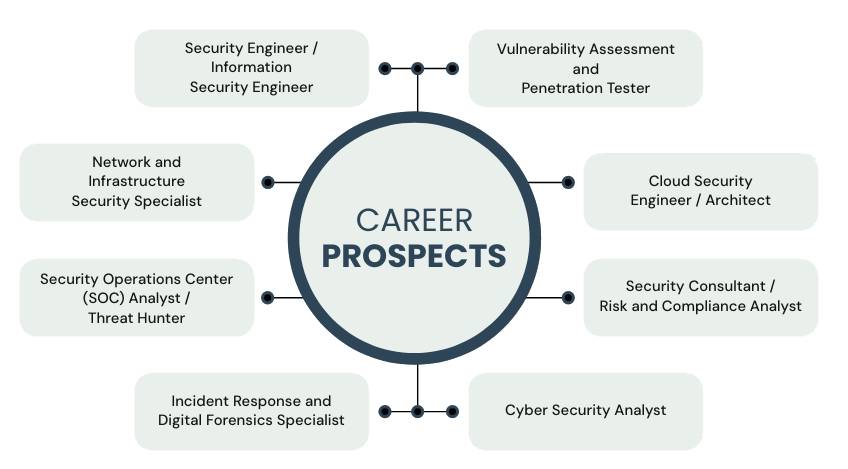
Career Prospects
Admission Process
- Admissions will be given based on score obtained in graduation and personal interview.
- Candidates who have appeared in the final year examination can also apply.
- GLS University reserves the right to make any exception in the above rules without any notice. However, in case of any doubt regarding interpretation of any clause, the decision of the University authorities shall be final.
- Allocation for SC, ST, SEBC etc. categories will be as per the rules of the University and State Government of Gujarat prevailing at the time of admissions.
Eligibility Criteria
The candidate should have passed any of the qualifying examination as mentioned during the current year:
- Bachelor's Degree in Computer Science | Computer Applications | Information Technology
- Bachelor's Degree in Engineering or Technology
- Bachelor's Degree in Science | Commerce | Business Administration
- Any Bachelor's Degree + PGDCA from UGC recognized University
Pedagogy
A variety of methods, including lectures, presentations, webinars, hands-on sessions, workshops,
MOOCs, interactive discussions, study tours, and industry projects, are utilized to strengthen students'
conceptual understanding, analytical skills, knowledge acquisition, and decision-making abilities,
preparing them to meet the challenges of the professional world. The pedagogy also incorporates case
studies, group collaborations, peer learning, flipped classrooms, and real-time simulations to promote
active engagement and critical thinking. Instruction takes place in well-maintained classrooms and
computer labs that are regularly sanitized to ensure a conducive learning environment.
Live Projects
Though classroom learning is given emphasis at FCAIT-PG, M.Sc. (Cyber Security) Programme, students are required to undertake a number of practical projects in the different courses of the programme for which the information gathered from business/industry is analyzed and presented in the form of reports.
Capstone Project
Every student in the final semester of the programme is required to undertake a live full time project assignment in the industry. A student chooses a topic on which primary data is gathered and analyzed in order to prepare a working system, for which he/she is supposed to work in the industry for 6 months. At the end of the duration a project report for the same is prepared that is evaluated by a panel of experts.
Syllabus
| Semester I | Semester II |
|
|
| Semester III | Semester IV |
|
|